A play-based curriculum with a framework you will recognise
The learning objectives within The Creative Curriculum are designed to build the skills, knowledge and dispositions children need for their future learning and school success. Our goal is to give children a strong, well-rounded foundation while making the transition to any curriculum school in Dubai as smooth and confident as possible.
The Creative Curriculum
Structure for the adults, freedom for the children
The Creative Curriculum is a research-based early childhood framework used widely in the United States and internationally. Its unit of planning is the study — an investigation lasting about six weeks of something children can touch, test and revisit: buildings, water, wheels, trees, light and shadow, or the market.
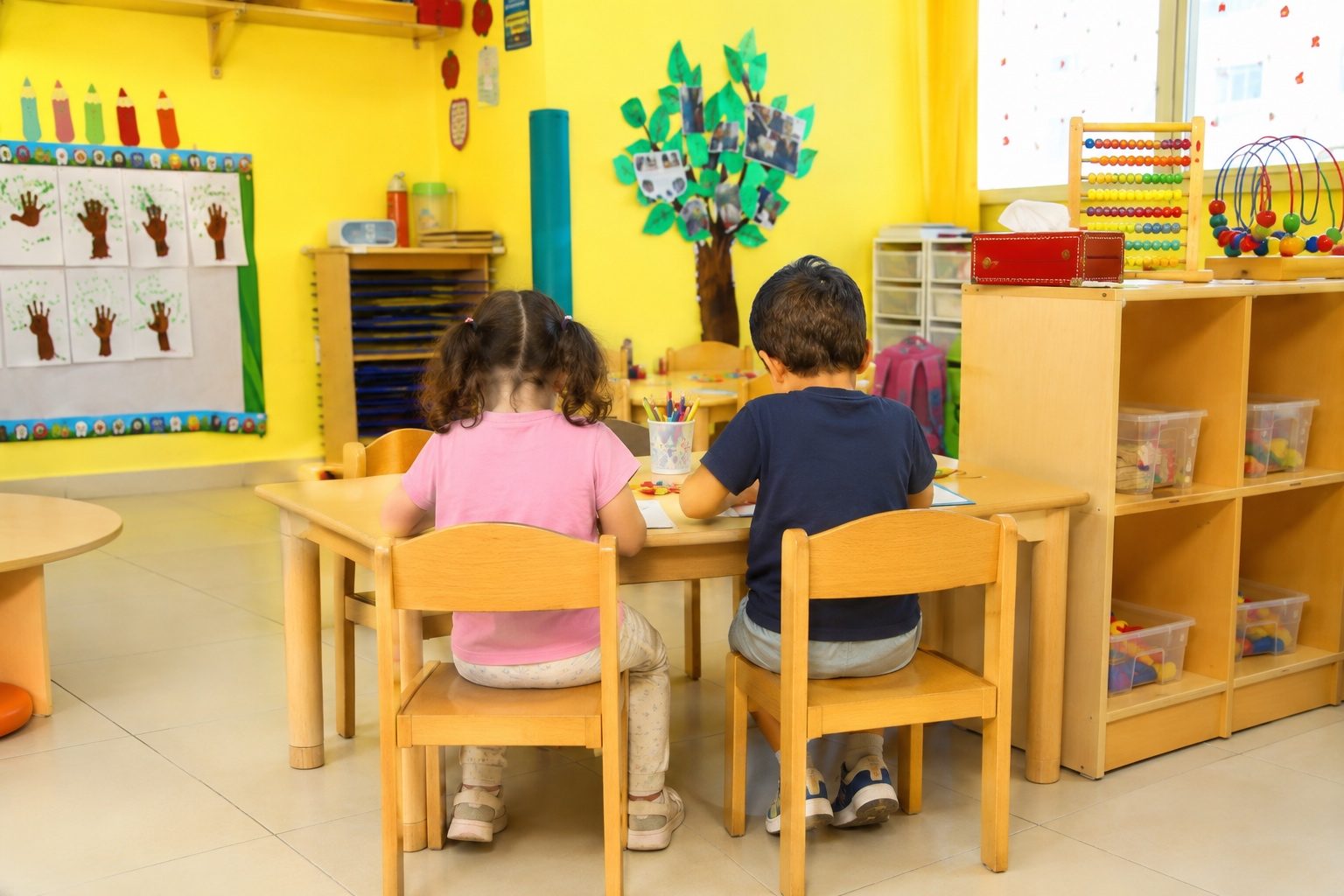
During a study the room changes around the question. A study of buildings brings in real bricks, blueprints, cardboard tubes, photographs of local towers, and a visit from a parent who is an architect. Children who can already count will measure; children who are still exploring will stack and knock down. Both are working on the same question at their own level.
For practitioners, the curriculum supplies objectives for development and learning, observation prompts, and a structure for preparing the environment. For children, it looks exactly like play — which is the point.
Arabic language exposure and Islamic and Emirati cultural awareness are built into the week for all children, in line with UAE early years guidance, and are taught by our Arabic specialist rather than added on as an extra.
The ten areas of learning
We plan for ten areas of learning. The cards below show how learning comes into the day.
Communication & language
Listening, attention, understanding and speaking. We narrate, we wait, and we ask questions with more than one right answer. Children with English as an additional language — the majority at Mosaic — are supported with visual cues, songs and consistent phrasing.
Physical development
Gross-motor work in the Playroom and huge indoor gym; fine-motor work with tweezers, drawing and collage. Self-care — pouring, buttoning, hand-washing, toileting — is treated as curriculum, not as an interruption to it.
Personal, social & emotional
Naming feelings, waiting a turn, resolving a dispute over a coveted digger. We use positive guidance rather than sanctions: an adult stays close, describes what happened, and helps both children find the words. This is the area parents notice changing first.
Literacy
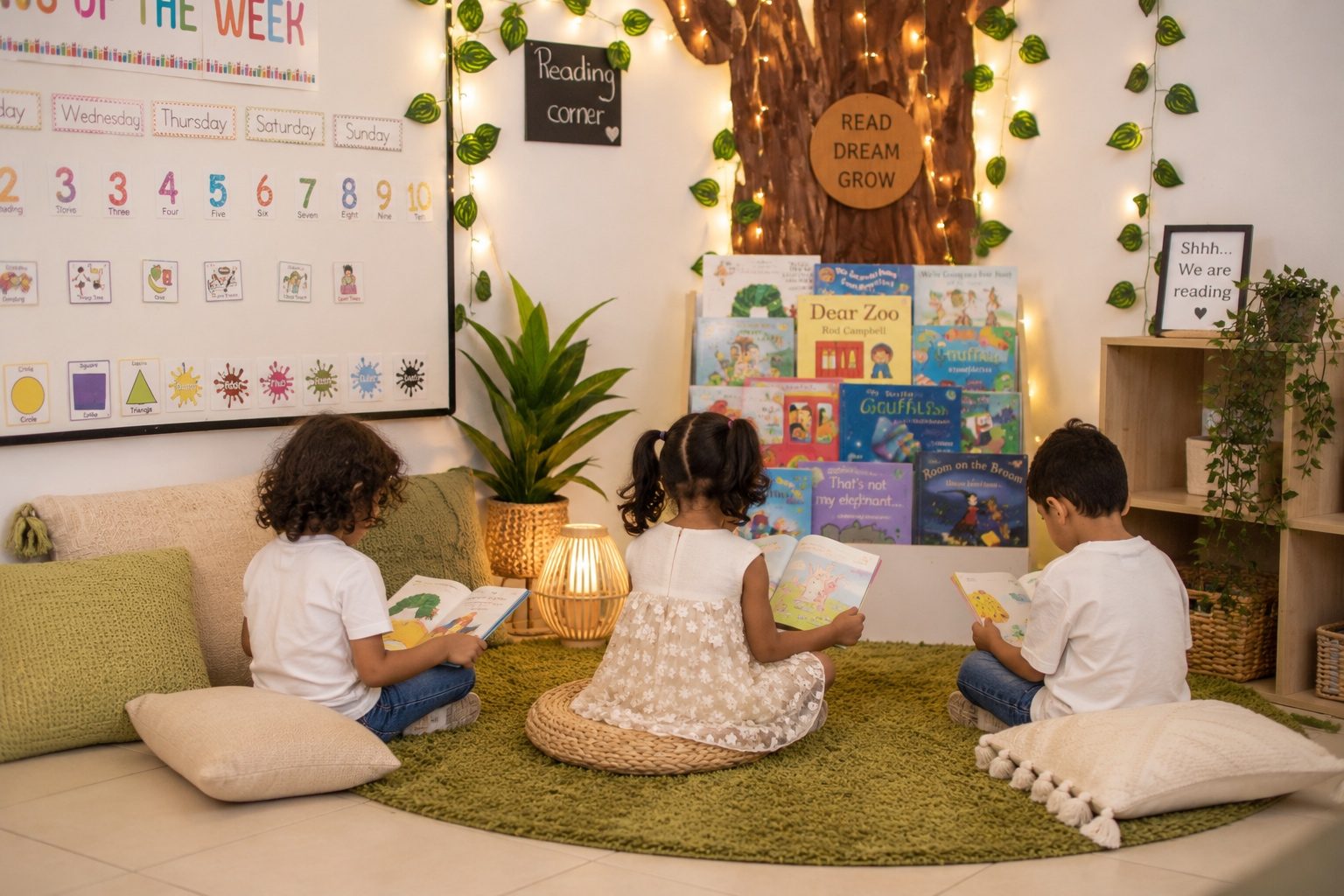
Daily stories, rhymes and songs; mark-making everywhere; name recognition; and in the final year an introduction to phonics through sound games rather than worksheets. Books are on open, front-facing shelves in every room.
Mathematics
Number, pattern, shape, measure and space through real problems — how many plates, whose tower is taller, will this fit. Loose parts and block play do more mathematical work at this age than any printed resource.
Understanding the world
People, places, the natural world and technology. Dubai's own seasons and festivals all become material. Cultural celebrations across our families are marked through the year.
Expressive arts & design
Open-ended art with real materials and no adult-made models to copy; clay, paint, collage, construction; music and movement; and a great deal of pretend play, which is where three-year-olds do their most complex thinking.
Characteristics of effective learning
Alongside the ten areas we record how your child learns: playing and exploring, active learning, and creating and thinking critically. This is often the most useful part of a report for a receiving school.
Arabic & Islamic awareness
Arabic language sessions twice weekly for all children from age two, plus Islamic and Emirati cultural awareness woven into the calendar in line with UAE guidance for early years settings.
How a study runs
Six weeks on one question
A study is not a theme with matching bunting. It is a question the children can investigate for six weeks, and it ends when their interest does rather than when the calendar says so.
Week 1
Beginning
The room is set up to provoke the question, and practitioners record what children already know, notice and wonder. Parents receive a letter asking what your child talks about at home.
Weeks 2–4
Investigating
Materials, books, visits and visitors arrive as the questions sharpen. Children test ideas, argue about them, and represent what they find in drawings, models, photographs and words.
Week 5
Deepening
Small adult-led groups take the parts of the question that need teaching — a measuring skill, a vocabulary set or a creative technique — and hand them straight back into the play.
Week 6
Closing
The children decide how to show what they learned: a wall, a model, a book, an event for parents. Practitioners write up the study and what individual children did inside it.
Studies run in Early Learners, Preschool and Pre-KG. Toddlers follow the same principle at a shorter cycle, built around interests rather than a written question.
At each age
What this looks like across 18 months – 5 years
The curriculum is the same in every room; what changes is what the adults are watching for. Full detail for each programme, including ratios and session options, is on the programmes page.
18 – 24 months
Toddlers
Walking, climbing and carrying heavy things across the room
First words, then two words together, then naming what they want
Eating at a low table with a spoon and an open cup
2 – 3 years
Early Learners
Sentences of four or more words, and asking for what they need
Toilet learning, at their pace and consistent with home
Taking a turn with an adult nearby, and recovering when it goes wrong
3 – 4 years
Preschool (FS1)
Sustained pretend play with two or three other children
Hearing the first sound in a word, and mark-making with intent
Counting reliably, and using number to solve a real problem
4 – 5 years
Pre-KG (FS2)
Writing their own name, and hearing sounds all through a short word
Counting on and back, and recording numbers their own way
Sustaining attention in a group for ten to fifteen minutes
Final year before school
School Readiness
Separating calmly at a door that is not ours
Asking an unfamiliar adult for help, out loud
Holding a pencil comfortably and writing their name unaided
2 – 5 years
Enrichment Activities
One new physical or creative skill, practised weekly for a term
Working with a coach who is not their key person
Joining a group of children from other rooms
Observation & assessment
Learning journals, not tick lists
Each child has a digital learning journal maintained by their key person on the parent app. It holds photographs, short written observations, samples of work, and the practitioner's interpretation of what the child was actually doing — which is the part that matters. You can see it at any time, add your own observations from home, and comment on anything.
Digital learning journal, visible to parents in real time
Moderation between rooms each term, so judgements are consistent
Sharing progress
What you hear, and when
Daily notes and photographs reach the parent app during the day, and every collection includes a two-minute verbal handover. If something goes wrong we telephone you; we do not save it for pick-up.
Formally, we meet you twice a year for a ten-minute conference and write two progress summaries. Once a term there is an open morning where you can spend an hour in the room, and once a year your child's key person invites you to look through the learning journal together.
Daily notes and photographs on the parent app
Two parent conferences a year, ten minutes each
A termly open morning in your child's own room
Direct messages from your child's key person, not a general newsletter
Transition to school
Ready for a Dubai classroom, without being drilled
Applications to Dubai primary schools typically open a year before entry, and most of our families are applying in the autumn term for the following September. We help in three ways: we write an honest transition report for the receiving school on request, we prepare your child for assessment mornings without rehearsing them, and we host an information evening in October on choosing and applying to schools in Dubai.
School readiness at Mosaic does not mean early formal work. It means a child who can separate from a parent calmly, ask an unfamiliar adult for help, sit in a group, manage their own belongings, hold a pencil comfortably, hear the first sound in a word and — above all — believe that school is a place where they will be fine.
A transition report for the receiving school on request, shared with you first
Mock school mornings through the summer term
An October information evening on Dubai school applications
A handover call with the receiving school, with your consent
A significant proportion of children in Dubai nurseries are growing up with two or three languages at home, and it is normal for expressive English to lag behind comprehension in the early years. Our practitioners are trained to tell the difference between multilingual development and a delay that needs support — and to raise it with you early rather than waiting.
Where a child needs more, our inclusion lead writes an individual education plan with you, sets short review cycles, and coordinates with external therapists. Visiting speech and language and occupational therapists may work with a child inside the nursery day, in a quiet space away from the room, with our practitioners observing so that strategies carry over into the classroom.
Early identification through key-person observation
Individual education plans reviewed every six to eight weeks with parents
Space for visiting therapists to work on site, with parental consent
Support with referrals, reports and applications for additional school support
Shadow teachers accommodated where a child's plan requires one
The best way to choose a nursery is to stand in the room while it is being used. Tours run on weekday mornings, take about forty minutes, and always finish with time for your questions — no sales pitch, no obligation.
Or call +971 4 425 6670 · we answer between 8:00 AM and 6:00 PM, Monday to Friday.
Visit us
Book a tour of Mosaic
Tours run on weekday mornings between 9:30 and 11:00, while the rooms are in full flow — so you see a real day, not a staged one. Leave three details and we will confirm by WhatsApp within one business day.
Your request is on its way
Send the WhatsApp message that just opened and our admissions lead will reply within one business day with two or three slot options. If WhatsApp did not open, call us on +971 4 425 6670.